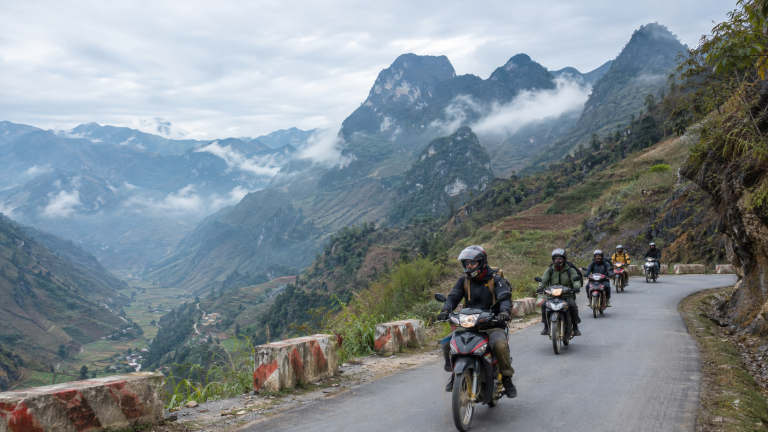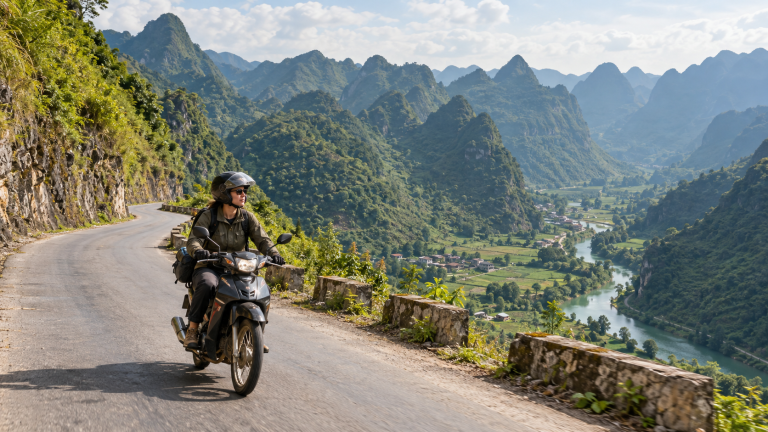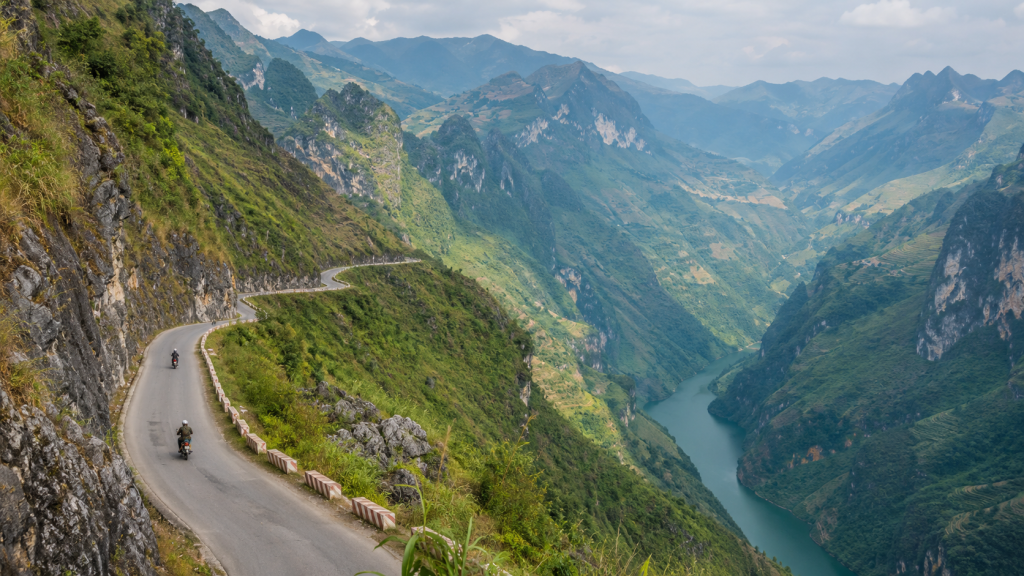
Ma Pi Leng Pass is one of the most famous sections of the Ha Giang Loop and, for many travelers, one of the highlights of the entire trip.
The road runs between Dong Van and Meo Vac, high above the Nho Que River and the deep mountain valleys of northern Vietnam. The towns are only around 24 km apart, but this section often takes much longer than the distance suggests because there are so many places to stop for the views.
You do not need a separate trip just for Ma Pi Leng.
It is already part of the classic Ha Giang Loop and appears on most 2-, 3-, and 4-day routes.
The main question is how much time you have to enjoy it.
Where Is Ma Pi Leng Pass?
Ma Pi Leng lies on the road between Dong Van and Meo Vac in the Dong Van Karst Plateau area of Ha Giang.
It is part of the famous mountain road generally known as the Happiness Road.
The pass reaches roughly 1,500 meters above sea level, with steep limestone mountains and the Nho Que River far below.
If you are following the classic Loop clockwise, you normally stay in Dong Van before travelling across Ma Pi Leng toward Meo Vac.
That makes the pass one of the natural highlights of the middle part of the trip rather than a separate detour.
Why Is Ma Pi Leng So Famous?
The main reason is the scale of the landscape.
The road follows the mountainside with huge limestone peaks rising around it and deep valleys dropping below.
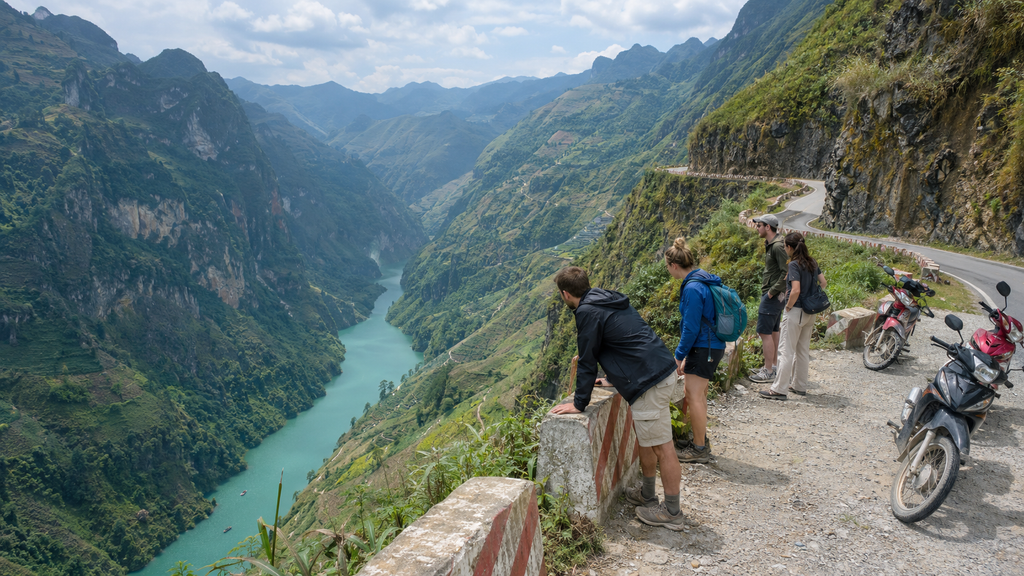
From several points along the route, you can see the Nho Que River winding through the canyon beneath the road.
Vietnam Tourism describes the Dong Van–Ma Pi Leng section as one of the most spectacular stretches of road in the country.
But Ma Pi Leng is not one single viewpoint.
The experience is the entire road.
You ride or drive through changing angles of the mountains, stop at roadside viewpoints, and gradually move from the Dong Van plateau toward Meo Vac.
That is why rushing through the pass only to take one photograph misses much of the point.
How Long Does Ma Pi Leng Pass Take?
The direct distance between Dong Van and Meo Vac is relatively short.
Vietnam Tourism puts it at around 24 km.
But you should not plan it like a normal 24 km transfer.
With photo stops, viewpoints, and slower mountain driving, it can easily take most of the morning as part of a Loop itinerary.
That is normal.
If the weather is clear, you will probably want to stop several times.
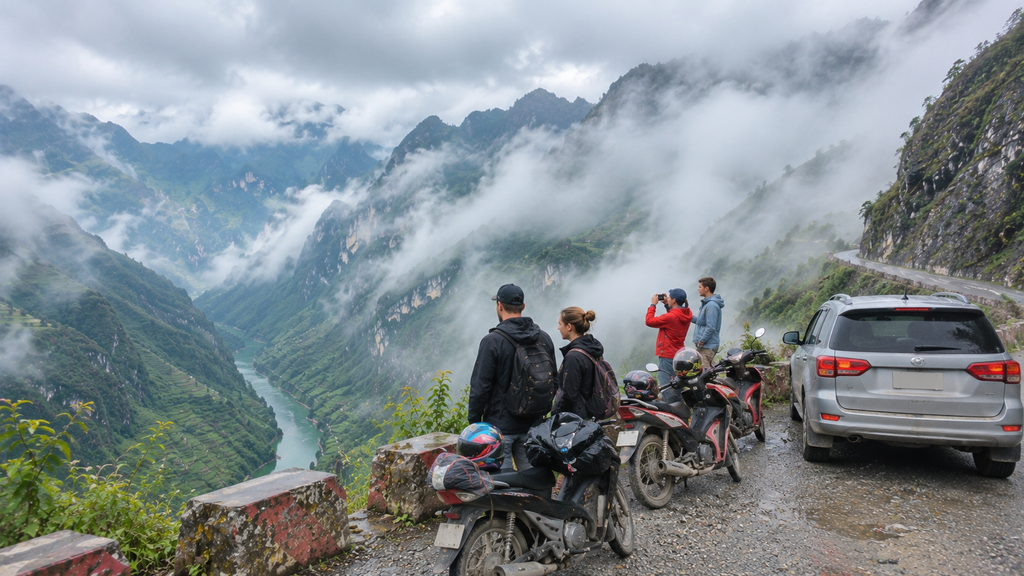
If there is fog, you may also wait at a viewpoint to see whether the cloud moves.
A longer itinerary gives you more flexibility here.
Our comparison of the Ha Giang Loop in 2, 3, or 4 days explains why the same route can feel very different depending on how many days you have.
What Are the Best Views at Ma Pi Leng?
The most famous views are toward the limestone mountains, the Nho Que River, and the Tu San Canyon area.
There are multiple roadside stops rather than one mandatory viewing platform.
Some viewpoints are directly beside the main road.
Others require a short walk or detour.
One of the better-known experiences is the Sky Path, which offers higher views over the river, mountains, and Happiness Road.
Vietnam Tourism describes a steep route through the mountains with views over the Nho Que River and surrounding peaks.
If you want to walk farther away from the road, wear proper shoes rather than sandals.
Do not assume every viewpoint has barriers or the infrastructure of a developed tourist attraction.
Can You See the Nho Que River from Ma Pi Leng?
Yes.
This is one of the defining views of the pass.
From high sections of Ma Pi Leng, the Nho Que River appears far below between the mountains.
The river and Tu San Canyon area are closely connected with the Ma Pi Leng experience.
But seeing the river from above and taking a boat trip are two different activities.
The boat area requires leaving the main pass road and descending toward the river.
So if a Nho Que boat trip is important to you, check whether it is actually included in your chosen itinerary.
Our next dedicated Nho Que guide will go into that experience in more detail.
Is the Nho Que River Boat Trip Part of Every Tour?
No.
Do not assume that seeing “Nho Que River” in a tour description automatically means a boat trip is included.
Some itineraries include viewpoints over the river.
Others include time to descend toward the boat area.
Longer routes generally have more room for optional activities.
For example, our 3-day Ha Giang Loop small group tour includes Ma Pi Leng and the Nho Que River area as part of the classic route.
If the boat trip is one of your priorities, ask specifically before booking.
What Is the Road Like?
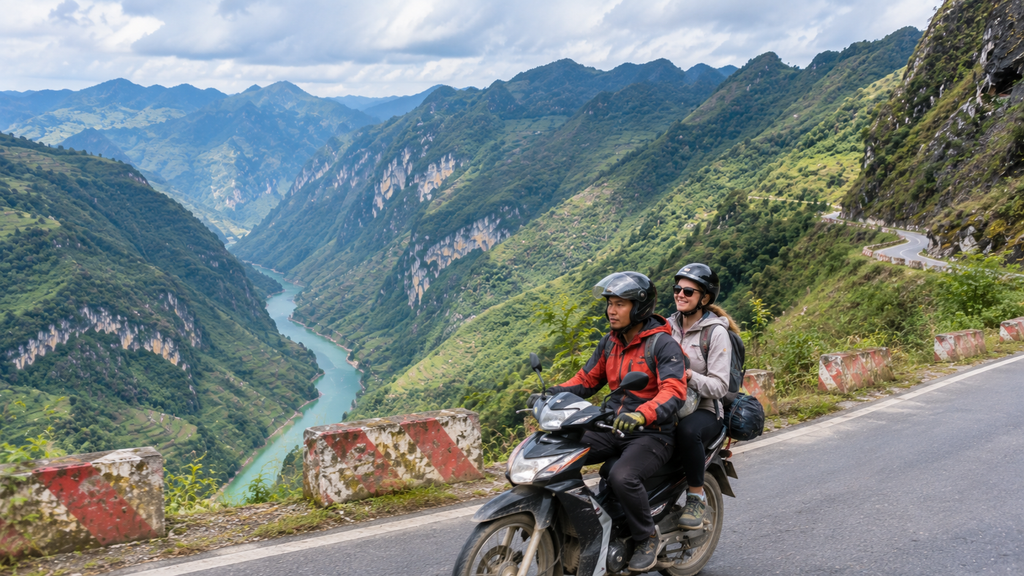
Ma Pi Leng is a mountain road with repeated bends, steep terrain, and exposed scenery.
The road itself is part of the attraction.
That does not mean it should be treated casually.
Visibility can change quickly, especially in fog.
Traffic can include motorcycles, cars, minibuses, and local vehicles.
Road surfaces can also become wet after rain.
If you are self-driving, you should already be comfortable controlling a motorcycle on mountain roads.
This is not a good place to learn basic riding skills.
Our Ha Giang Loop license and IDP guide also explain the legal side of self-driving in Vietnam.
Easy Rider or Self-Drive at Ma Pi Leng?
For inexperienced riders, I would choose an Easy Rider.
You still travel the pass on a motorbike and experience the open mountain scenery, but a local driver handles the road.
That also makes it easier to look around.
When you self-drive, your attention needs to stay on the road.
When you ride as a passenger, you can spend more time looking at the landscape.
Experienced riders may prefer self-driving, but experience matters more than the desire to say you rode the road yourself.
Our Easy Rider vs. Self-Driving Guide compares both options.
Can You Visit Ma Pi Leng by Car?
Yes.
A private car or SUV can follow the main route between Dong Van and Meo Vac.
You do not have to travel by motorbike to see Ma Pi Leng.
A car makes particular sense for:
- families;
- older travellers;
- people who dislike motorcycles;
- travelers visiting during cold weather;
- people carrying more luggage;
- anyone prioritizing comfort.
Motorbikes are easier for small roadside stops, but the major scenery is not exclusive to riders.
Our Ha Giang Loop by car vs. motorbike explains the trade-offs.
What Is the Weather Like at Ma Pi Leng?
Mountain weather can change quickly.
One moment the valley may be visible.
Later, clouds can cover large parts of the pass.
Winter often brings cold temperatures and fog.
Summer can bring heavier rain and wet roads.
Clear conditions are never guaranteed, regardless of the month.
This matters because Ma Pi Leng is primarily about the views.
If you arrive in fog, do not immediately assume the entire day is ruined.
Clouds can move quickly through the mountains.
Sometimes waiting a little at a viewpoint produces a completely different view.
For a broader seasonal comparison, see our guide to the best time to visit the Ha Giang Loop.
Is Ma Pi Leng Good in December?
Yes, but expect colder conditions.
December is generally drier than the summer wet season, but fog and low cloud can affect visibility.
The combination of altitude, wind, and hours on a motorcycle can also make the pass feel much colder than the temperature suggests.
If you are travelling in winter, bring proper layers and gloves.
Our guide to the Ha Giang Loop in December covers winter weather and packing in more detail.
When Is the Best Time of Day to Visit?
There is no single guaranteed best hour.
Morning can bring mist.
Later in the day can bring clearer conditions, but that is not a rule.
Weather in the mountains is too variable to plan around one exact time.
Instead, avoid rushing.
If you are staying in Dong Van, leaving in the morning gives you enough time to enjoy the road before continuing toward Meo Vac.
If your tour happens to cross during good weather, use the opportunity.
Do not assume you can simply return later if the itinerary continues to another part of the Loop.
Is Ma Pi Leng Dangerous?
The landscape is dramatic, but the main practical risks are the same ones found across the mountain sections of the Loop:
- inexperienced riding;
- excessive speed;
- fog;
- wet roads;
- overtaking;
- poor visibility;
- stopping in unsafe places.
The pass should be approached as a mountain road, not as a racetrack.
If you stop for photographs, make sure the motorcycle or vehicle is properly off the active road.
Do not stand in the road for pictures.
At unfenced viewpoints, stay away from exposed edges.
The best view is not worth taking unnecessary risks.
Is the Sky Path Worth It?
It can be if you want a different perspective and are comfortable walking.
The Sky Path gives you higher and more exposed views away from the standard roadside stops.
Vietnam Tourism highlights it specifically for views of the Nho Que River, mountain ranges, and the historic road.
But it adds time.
If you are doing a compressed 2-day Loop, you may not have much space for longer stops.
On a 3- or 4-day route, it can be easier to fit in.
This is another reason not to think only in terms of the shortest possible itinerary.
Which Ha Giang Tours Include Ma Pi Leng?
Ma Pi Leng is part of the classic Ha Giang Loop, so it appears in most standard itineraries.
The 2-day small group tour crosses the pass on the second day between Dong Van and Meo Vac.
The 3-day small group tour also includes Dong Van, Ma Pi Leng, and Meo Vac as part of the classic route.
Longer 4-day routes include the same major area but give the overall trip more breathing room.
Ma Pi Leng also appears on longer trips continuing beyond Ha Giang toward Cao Bang.
So you do not need to choose a special “Ma Pi Leng tour.”
You mainly need to choose how much time you want for the wider Loop.
Is Ma Pi Leng Pass Worth It?
Yes.
If you are already travelling the Ha Giang Loop, Ma Pi Leng is one of the sections you should not skip.
It combines the road itself, high mountain scenery, views toward the Nho Que River, and the transition between Dong Van and Meo Vac.
But it is better understood as a section of the journey, not one viewpoint to tick off a list.
Give yourself time.
Stop when conditions are good.
And choose a travel style that lets you enjoy the scenery rather than spend the entire section stressed about the road.
FAQ
Where is Ma Pi Leng Pass?
Ma Pi Leng Pass lies between Dong Van and Meo Vac in Ha Giang, northern Vietnam, on the classic Ha Giang Loop route.
How far is Ma Pi Leng from Dong Van?
Meo Vac is around 24 km from Dong Van via the Ma Pi Leng section, but sightseeing and photo stops make the journey much longer than a normal 24 km drive.
Can you see the Nho Que River from Ma Pi Leng?
Yes. Several viewpoints along the pass overlook the Nho Que River and surrounding canyon.
Do you need to take a boat trip to enjoy Ma Pi Leng?
No. The pass itself offers major mountain and river views. A Nho Que River boat trip is an additional activity.
Can you drive Ma Pi Leng by car?
Yes. The main route can be travelled by car or private SUV as well as by motorcycle.
Is Ma Pi Leng difficult to ride?
It is a mountain road with bends, steep terrain, and changing weather. Inexperienced riders should consider travelling with an Easy Rider rather than learning to ride there.
Is Ma Pi Leng foggy?
It can be. Fog and low cloud are particularly important variables in the mountains, and visibility can change quickly.
How long should you spend at Ma Pi Leng?
There is no fixed amount of time. The Dong Van–Meo Vac section can take much of a morning when you include viewpoints and stops.
Is Ma Pi Leng included in a 3-day Ha Giang Loop?
Yes. It is one of the main highlights of the classic 3-day route.
Is Ma Pi Leng worth visiting if the weather is cloudy?
Usually yes. Mountain clouds can create dramatic scenery and may move during the day, although clear views are never guaranteed.