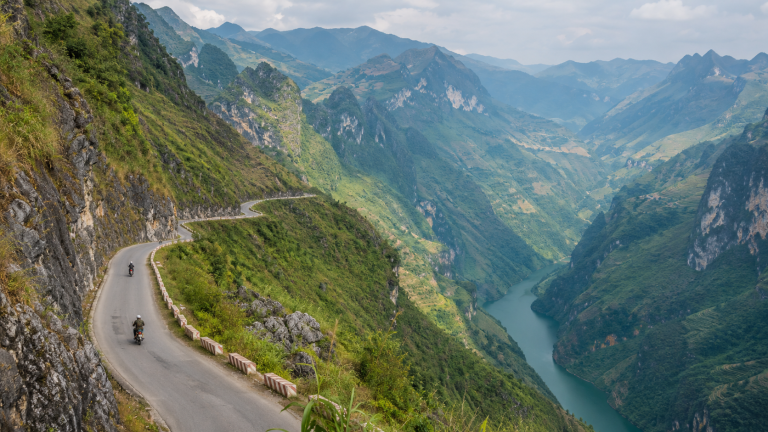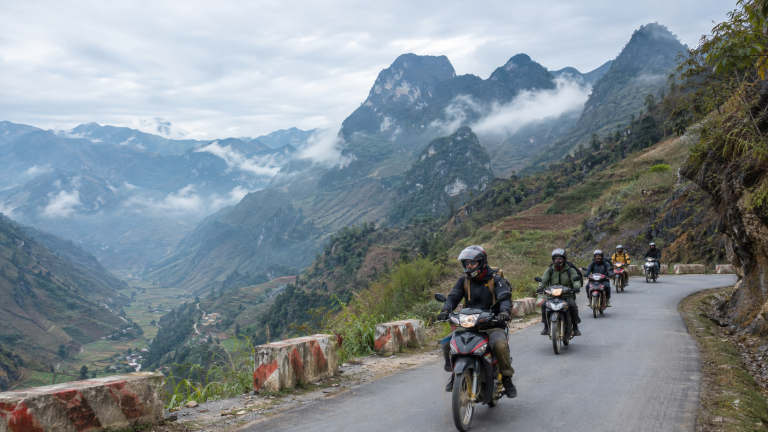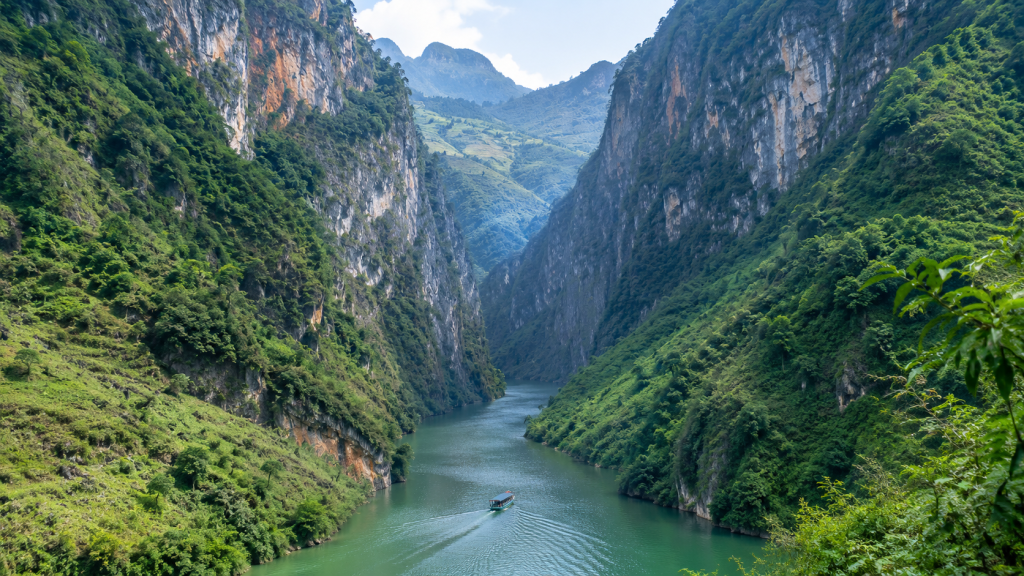
The Nho Que River is one of the most recognizable sights on the Ha Giang Loop.
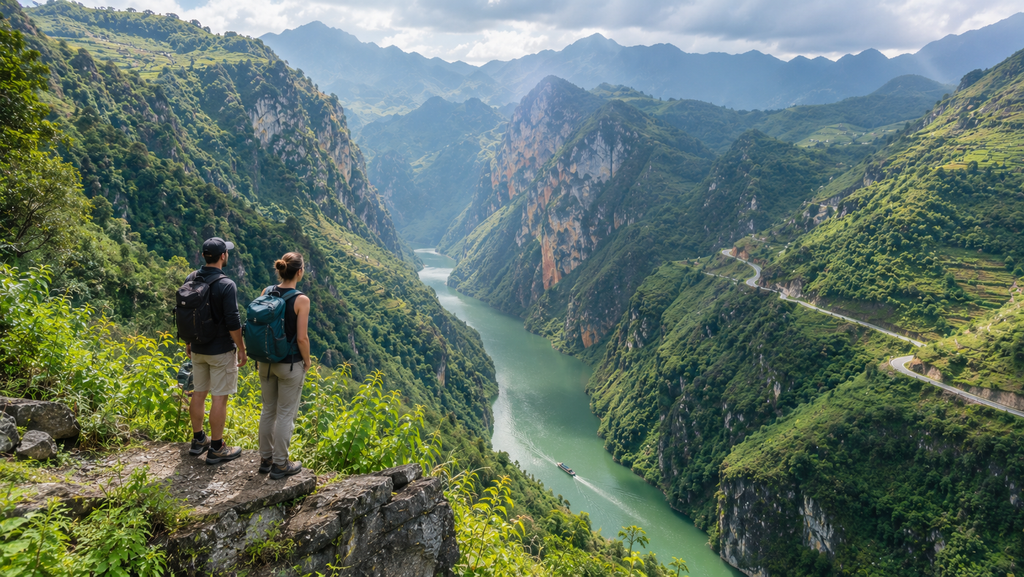
From Ma Pi Leng Pass, you see the river far below, winding between huge limestone mountains. But if your itinerary has enough time, you can also descend from the main Loop and take a boat into Tu San Canyon.
The two experiences are very different.
Seeing the river from Ma Pi Leng gives you the scale of the landscape.
Taking the boat puts you at the bottom of the canyon, directly between the cliffs.
For many travellers, doing both is one of the highlights of Ha Giang.
Where Is the Nho Que River?
The section visited by most Ha Giang Loop travellers lies below Ma Pi Leng Pass, between Dong Van and Meo Vac.
The river runs through Tu San Canyon beneath the high limestone mountains of the Dong Van Karst Plateau.
If you are following the classic Loop, you normally reach this area after staying in Dong Van and travelling toward Meo Vac.
That means the river fits naturally into the same day as Ma Pi Leng.
It is not usually a separate destination requiring another trip from Ha Giang City.
Our Ma Pi Leng Pass guide explains the road and viewpoints above the river in more detail.
What Is Tu San Canyon?
Tu San Canyon is the dramatic gorge surrounding the Nho Que River below Ma Pi Leng.
From the road above, the canyon looks narrow because you are viewing it from a great height.
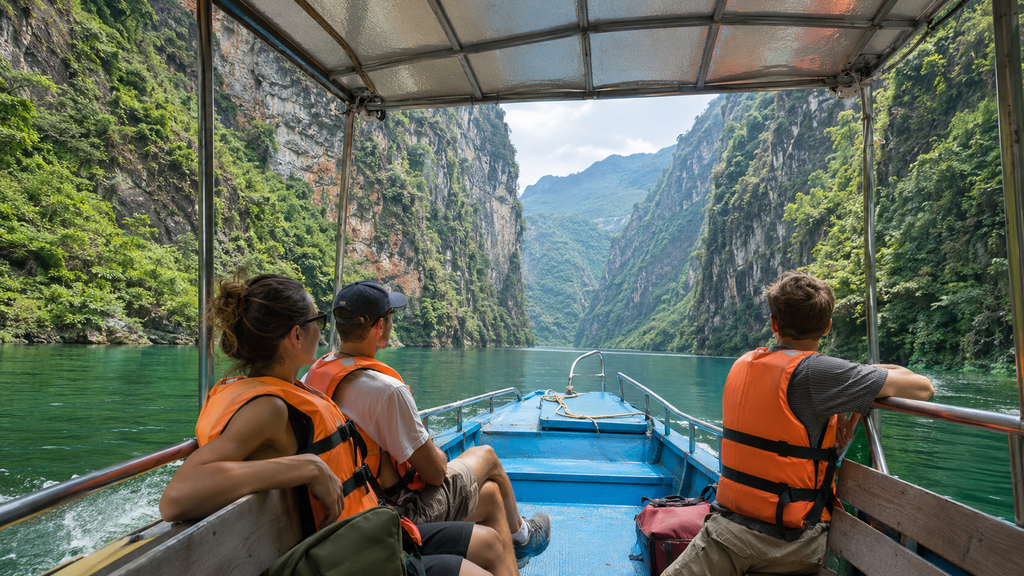
From the boat, the perspective changes completely.
You travel between large limestone walls while the mountains rise on both sides of the river.
This is the main reason to take the boat rather than simply stopping at viewpoints.
The viewpoint gives you the panorama.
The boat gives you the scale of the canyon itself.
Do You Need to Take a Boat?
No.
You can still experience the Nho Que River without going down to the water.
Several areas around Ma Pi Leng provide views of the river from above.
If you only have a short itinerary, the viewpoints may be enough.
I would prioritize the boat if:
- you have enough time in the itinerary;
- the weather and river conditions are suitable;
- you specifically want to experience Tu San Canyon;
- you do not mind adding a descent and transfer to the day.
I would consider skipping it if:
- your itinerary is already rushed;
- weather has disrupted the day’s schedule;
- access to the river is temporarily restricted;
- you would rather spend more time around Ma Pi Leng viewpoints.
The boat is a very good addition to the Loop, but it should not turn the entire day into a race.
What Is the Nho Que River Boat Trip Like?
The standard experience is a sightseeing boat trip into Tu San Canyon.
After reaching the river access area, you buy or collect your ticket, travel to the boarding point, and join a boat.
The boat then moves along the river between the canyon walls before returning.
Depending on the service and current operations, the boat portion itself is commonly around 45–80 minutes.
However, the total visit takes longer.
Once you include the descent from the main road, parking, shuttle transfers, waiting, and returning to the Loop, it is sensible to allow roughly 2–3 hours for the overall activity.
That is the figure that matters when planning your Ha Giang itinerary.
How Much Does the Nho Que River Boat Cost?
Prices and ticket arrangements can change, so you should check the current rate with your tour operator or at the ticket office.
Recent 2026 reports indicate a standard fare around 150,000 VND per person for passengers over 1.2 meters tall, with a lower rate reported for smaller children.
Some published 2026 information gives 80,000 VND for passengers 1.2 meters or shorter.
The reported 2026 fare included elements such as the boat trip, shuttle transfer, passenger insurance, and VAT, but you should not assume that every access point or service has identical inclusions.
Older online guides often show different prices.
Use them only as an estimate.
If you are joining an organized Ha Giang Loop tour, ask whether the boat ticket is already included in the tour price or paid separately.
Is the Boat Trip Included in Ha Giang Loop Tours?
Not always.
This is worth checking before you book.
Some tour descriptions mention the Nho Que River because the itinerary passes viewpoints above it.
That does not automatically mean a boat trip is included.
Other tours specifically allow time to descend and take the boat.
So ask:
“Does the itinerary include the Nho Que River boat trip, or only the viewpoint?”
The distinction matters, particularly on shorter tours.
Our 3-day Ha Giang Loop small group tour passes through the Ma Pi Leng and Nho Que area as part of the classic Loop.
Longer itineraries generally give more room for activities that take you away from the main road.
How Do You Get Down to the River?
This is where outdated travel information can cause confusion.
Access arrangements and boarding locations around the Nho Que River have changed over time.
You should not simply follow an old blog post to a specific pier.
The practical route usually involves leaving the main Ma Pi Leng area, descending toward the river access point, parking, and then using a local shuttle or transfer for part of the journey to the boats.
Some approaches are steep and winding.
Current pier arrangements can also change because of road conditions, construction, water levels, or local operating decisions.
For that reason, ask your guide, homestay, or tour operator for the current boarding point on the day you visit.
If you are with an Easy Rider or organized tour, they normally handle this logistics problem for you.
Can You Drive Directly to the Boat?
Do not assume you can drive all the way to the water.
At current access points, visitors may need to leave their vehicle at a parking or ticket area and continue using a shuttle.
This also means the boat trip takes more time than simply looking at the river from Ma Pi Leng Pass.
For self-drivers, the descent deserves particular attention.
Some roads in the area are much steeper and narrower than the main QL4C route.
If you are not comfortable with difficult mountain roads, do not choose a challenging descent simply because an old map suggests it is the shortest way.
Is the Road Down Difficult?
It can be.
The main Ha Giang Loop already requires proper motorcycle control.
Smaller roads descending toward the river can be steeper, narrower, and more demanding.
Conditions may also change after rain.
This is another situation where an Easy Rider has an advantage.
A local driver is already familiar with mountain riding and current access arrangements, while you can focus on the experience.
If you plan to self-drive, make sure you are both legally permitted and genuinely experienced.
See our Ha Giang Loop license and IDP guide before deciding to ride independently.
When Is the Nho Que River Most Beautiful?
There is no guaranteed month when the river will look exactly like photographs online.
Its appearance depends on rain, water levels, light, and recent weather.
The famous turquoise or green color is generally easier to see when conditions are clearer and there has not been heavy rainfall.
After strong rain, sediment can make the river look browner or less vivid.
That does not mean the canyon stops being impressive.
The cliffs and scale of the landscape remain the main attraction.
But you should be skeptical of highly edited photographs suggesting the water always has the same bright colour.
It does not.
What Happens During the Rainy Season?
Heavy rain can affect both the appearance of the river and access to it.
Water may become muddier.
Mountain roads can become more difficult.
And boat services may be temporarily suspended if conditions are unsafe.
This has happened before following periods of flooding and severe weather.
If there has been heavy rain shortly before your trip, ask locally whether boats are operating normally.
Do not structure an entire Ha Giang trip around the assumption that the boat service can never close.
Our best time to visit the Ha Giang Loop explains how weather changes through the year.
What About December and Winter?
Winter can be a good time to see the river.
Rain is generally less intense than during the summer wet season, and clearer water is possible.
The downside is temperature.
Ma Pi Leng and the highland areas around Dong Van and Meo Vac can become genuinely cold.
It is often warmer once you descend toward the river, but you still need proper clothing for the motorcycle journey above.
Fog is another factor.
The river may be difficult to see from Ma Pi Leng in thick clouds, even though the boat area below remains accessible.
If you are visiting at the end of the year, read our Ha Giang Loop in December guide before packing.
Is the Nho Que River Safe?
The sightseeing boat trip is a managed tourist activity, but normal water safety still applies.
Wear the provided life jacket and follow the boat crew’s instructions.
Do not move around unnecessarily or crowd one side of the boat for photographs.
You should also respect any closure caused by weather or water conditions.
If operators suspend trips after heavy rain, that is a safety decision.
It is not something worth trying to work around to preserve your itinerary.
Can You Swim in the Nho Que River?
Do not plan the standard sightseeing trip around swimming.
The river in this area has boat traffic, steep canyon surroundings, and changing water conditions.
The normal activity is the boat ride through the canyon.
If you see separate kayaking, paddling, or water activities advertised, treat those as different products with their own operators and safety requirements.
Do not assume you can simply jump into the river during a sightseeing cruise.
Ma Pi Leng Viewpoint or Nho Que Boat?
Ideally, both.
They show the same landscape from completely different perspectives.
Ma Pi Leng viewpoint
Best for:
- panoramic photographs;
- seeing the shape of the canyon;
- viewing the road and river together;
- travellers with limited time.
Nho Que boat
Best for:
- experiencing Tu San Canyon from below;
- seeing the cliff walls at close range;
- travellers with more time;
- adding a different activity to several days of riding.
If you only have enough time for one, I would not rush your entire Loop simply to fit in the boat.
The Ma Pi Leng road itself is already one of the major experiences of Ha Giang.
Is 3 Days Enough to Include Nho Que River?
Yes, but the itinerary needs to be organized properly.
A 3-day Loop can include Ma Pi Leng and time around the Nho Que River.
But there is naturally less flexibility than on a 4-day route.
If waiting times are long or weather delays the day, a short itinerary has less room to absorb that delay.
A 4-day trip gives you more breathing room for viewpoints, the boat, and longer stops.
Our guide comparing the Ha Giang Loop in 2, 3, or 4 days explains the differences in pacing.

Should You Visit Nho Que River by Easy Rider or SUV?
Both are possible.
An Easy Rider gives you the classic open-air Loop experience and makes smaller roads and roadside stops easier.
A private SUV provides more weather protection and comfort.
For families, older travelers, or people visiting in cold conditions, an SUV can be the better overall option.
The important part is to confirm how the river transfer works with your specific vehicle.
A car may remain at a parking area while local transport handles the final access section.
See our Ha Giang Loop by car vs. motorbike comparison if you are still choosing between them.
Is the Nho Que River Worth Visiting?
Yes, if your itinerary has enough time.
The boat trip is not essential to say you have completed the Ha Giang Loop, but it adds a perspective you cannot get from the road.
From Ma Pi Leng, the canyon looks enormous because you are standing above it.
From the river, you understand how high the mountains actually are.
The mistake is trying to squeeze the activity into a schedule that is already too tight.
Give it enough time, check current operating conditions, and treat the boat as part of the Ma Pi Leng experience rather than a separate attraction you need to race toward.
FAQ
Where is the Nho Que River?
The section most commonly visited by Ha Giang Loop travellers lies below Ma Pi Leng Pass between Dong Van and Meo Vac in northern Vietnam.
What is Tu San Canyon?
Tu San Canyon is the dramatic limestone gorge surrounding the Nho Que River below Ma Pi Leng. Boat trips travel through the canyon and provide views from the bottom of the cliffs.
How much is the Nho Que River boat trip?
Recent 2026 information indicates a rate of around 150,000 VND for passengers over 1.2 meters, with a lower reported rate for smaller children. Prices and inclusions can change, so confirm locally.
How long does the Nho Que River boat trip take?
The boat ride itself commonly takes around 45–80 minutes depending on the service. Allow roughly 2–3 hours for the full experience, including transfers, waiting, and returning to the Loop.
Is the Nho Que boat included in every Ha Giang Loop tour?
No. Some tours only include viewpoints over the river. Check whether your itinerary specifically includes the boat trip and whether the ticket is included in the price.
Can you see the Nho Que River without taking a boat?
Yes. Ma Pi Leng Pass has viewpoints overlooking the river and canyon.
Can cars reach the Nho Que River?
Cars can reach the wider access area, but passengers may need to use a local shuttle for the final section to the boarding point.
Is the Nho Que River always turquoise?
No. The color changes with rainfall, sediment, water levels, and light. Heavy rain can make the water appear much muddier.
Can you swim in the Nho Que River?
Swimming is not part of the standard sightseeing boat trip. Follow the rules of the boat operator and do not assume swimming is permitted.
Is the Nho Que River worth adding to a 3-day Ha Giang Loop?
Yes, if the itinerary allows enough time. On a 4-day route, it is usually easier to include the boat without rushing other stops.